
Every plant protection treatment you carry out on your holding has to be recorded, and not just any note will do: the regulations set out which data must be included. An incomplete record is one of the most common failings in inspections and certification audits, and it almost always comes down to the same thing: it is written up late, from memory and in a rush. This article reviews which data is mandatory, which documents you need to keep and how to organise yourself so that the record is right first time.
Which regulation applies
The obligation is set out in article 16 of Real Decreto 1311/2012 (the Spanish Royal Decree on the sustainable use of plant protection products), and the specific data in part I of its annex III. At European level, Implementing Regulation (EU) 2023/564 sets the content and format of the records of plant protection product use kept by professional users.
Article 16 has been amended several times in recent years. According to its consolidated text in the BOE (the Spanish Official State Gazette), consulted in October 2026:
- On farms, the treatment record forms part of the digital farm logbook.
- In the agricultural sector, paper records are accepted until 31/12/2026.
- Logbooks for organic production, integrated production or other certification schemes that include the data in part I of annex III are also considered valid.
- The associated documentation must be kept for at least three years.
As the paper deadline is very close and the electronic record timetables have changed more than once, check the current position in the BOE or with your regional government. Everything relating to submission to the digital farm logbook (CUE) is explained by GAP on its digital logbook page.
The data for each treatment
Part I of annex III requires the following data for each plant protection treatment:
| Data | Practical tip |
|---|---|
| Date of treatment | The day it is applied, not the date of purchase or of the recommendation |
| Plot or premises treated | Identified in the same way as in the rest of the logbook, with its SIGPAC reference |
| Crop | Species and, for woody crops, variety, consistent with the plot |
| Area treated | The area actually treated, which may not be the whole plot |
| Pest or problem | The specific reason, not simply "preventive" |
| Product | Trade name and registration number |
| Quantity used | With its units |
| Application equipment | The equipment used, clearly identifiable |
| Applicator | The person applying and, where relevant, the adviser who recommends it |
| Efficacy | Assessment of how well the treatment worked |
| Remarks | Incidents, conditions or clarifications |
In addition, the record includes general information about the holding: the holder, people with a licence or adviser status, plots with their SIGPAC reference, area and crop, own application equipment with its inspection, and fertilisation and irrigation data. Check the full list in annex III, as it is only summarised here.
Which documents you need to keep
Article 16 requires the documentation accompanying the record to be kept for at least three years. This includes:
- Advisory documentation, if the holding is required to have an adviser.
- Inspection certificates for the application equipment.
- Contracts with treatment companies, if you outsource treatments to third parties.
- Purchase invoices for plant protection products.
- Residue analyses, if any have been carried out.
If a third party carries out the treatment as a service, they also have their own record-keeping obligations. Always ask for the treatment information so that you have it in your logbook.
How to organise your records without errors
- Write it up the same day. What is recorded at the end of the month is reconstructed from memory and goes wrong on dates, areas and quantities.
- Use a single source of truth for plots. If a plot has one name in the logbook and another in the foreman's notebook, there will be errors.
- Identify who carries out each treatment. The applicator must hold the licence of the appropriate level.
- Link the treatment to its reason: the sampling or observation that justifies it and the adviser's recommendation.
- Don't forget efficacy. Schedule a follow-up check and note the result.
- Review the record regularly before closing each month.
An example of a complete record
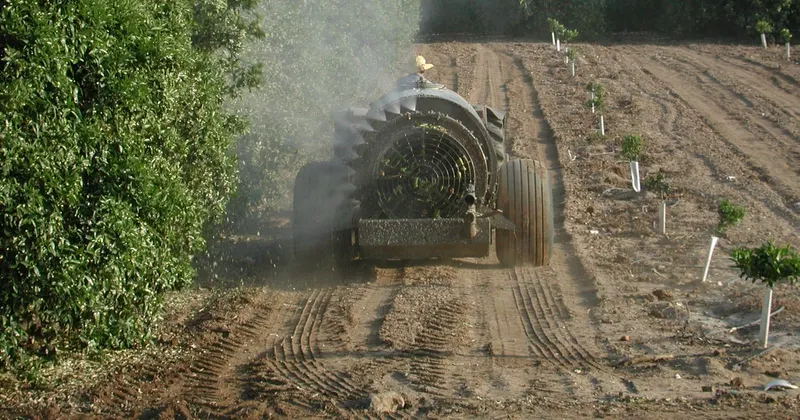
For example, a well-recorded treatment would read something like this: on a given day, on the plot identified by its SIGPAC reference, with an orange crop of a specific variety, 2.5 of its 3.8 hectares are treated against a particular pest, with a product identified by its trade name and registration number, in the quantity used, with the holding's air-blast sprayer, applied by a person with a basic-level licence following the adviser's recommendation. A week later, a sampling of the plot makes it possible to record the efficacy.
If anyone reading the record can reconstruct the treatment without having to ask you anything, it has been done well.
Common mistakes
- Writing down the area of the whole plot when only part of it was treated.
- Giving the product name without the registration number.
- Leaving the pest blank or writing "general".
- Not identifying the equipment or the applicator.
- Not assessing efficacy.
- Losing the invoices or inspection certificates before the three years are up.
Treatments in Agrimaps
With Agrimaps you have precise control over which technical operations have been carried out on your holding and who is responsible for each one. Technical operations tracking records all the treatments and the irrigation and fertilisation orders for your crops, and at the push of a button the field logbook is generated in the format required by the authorities.
Plots are loaded automatically with their official SIGPAC codes imported from the online register, so the treatment always goes to the right plot. And because pest sampling shows how treatments affect the status of each pest, you have the information at hand to assess their efficacy. You can see the rest of the features on the features page.