
The Mediterranean fruit fly, Ceratitis capitata, attacks citrus, stone and pome fruit, persimmon, fig and many other crops. The female pierces the fruit to lay her eggs, the larvae develop inside and the fruit drops or loses its value. Because the damage appears when the fruit starts to ripen, trap monitoring is the way to know when the population on your farm begins to grow. This article explains how to organise it and how to record your readings so that they help you make decisions.
When to monitor
The fly is active for a good part of the year in warm areas, but the risk to a particular crop is concentrated in the period when the fruit is receptive: from when it starts to change colour until harvest. Each crop and each variety has its own window, and on a farm with early, mid-season and late varieties the monitoring period is longer.
In addition, populations tend to grow with the heat and can move from one crop to another as they ripen in the area. That is why it is worth starting to trap before the fruit becomes susceptible, to establish the starting level, and carrying on until harvesting is finished.
How to set up the trap network
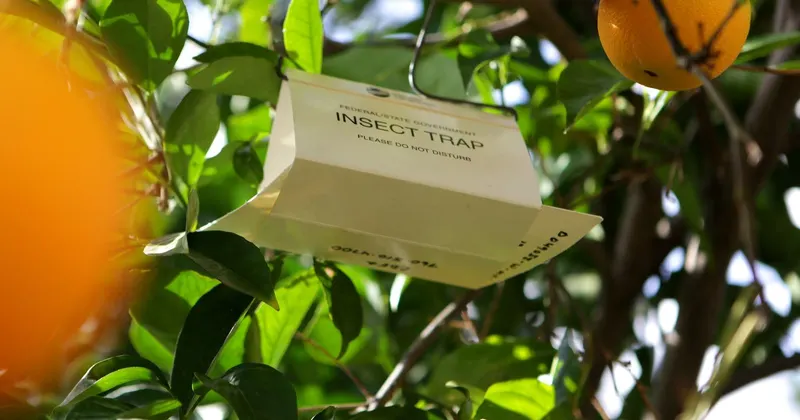
Monitoring uses fly traps with attractants. Some attract mainly males and others also attract females, which are the ones that cause the damage. Which type to use and how many per hectare are set out in the integrated pest management guides for each crop, by the warning stations in your region and by your adviser.
When placing them:
- Number each trap and note its position in the plot. Keep the same location throughout the season.
- Hang it in the canopy, at mid-height, in a shaded spot with no leaves blocking the entrance, following the manufacturer's and your adviser's instructions.
- Spread them out across the farm, including the edges that border other host crops, isolated fruit trees or abandoned fruit.
- Note the date of placement and of each change of attractant, according to the manufacturer.
- Do not use monitoring traps for mass trapping: if the farm also has mass trapping, make sure you can clearly tell which are the monitoring traps.
Checking and recording catches
Check the traps at a fixed interval, which is usually shortened at times of greatest risk. At each check:
- Count the flies caught. If the trap catches both sexes, separate males from females: females have an abdomen ending in a point (the ovipositor).
- Empty or clean the trap so you don't count the same individuals twice.
- Note the date and the days elapsed since the previous check.
- Calculate catches per trap per day by dividing the number of flies by the days elapsed.
- Note any incidents: a fallen trap, an exhausted attractant, insects of other species.
Why catches per trap per day
It is the unit that lets you compare readings taken at different intervals, and the one warning bulletins usually use. For example, 14 flies in 7 days and 10 flies in 5 days are the same: 2 flies per trap per day. If your data is in that unit, you can compare it with official warnings and with your previous seasons.
What to do with the data
Catches alone do not tell you when to intervene. The decision depends on how receptive the fruit is, the variety, the intended use of the fruit and the criteria set by the crop's integrated management guide for your area. Warning stations set those criteria and publish the situation at any given time.
What your data does give you:
- The trend in each plot, week by week.
- The hotspots on the farm, if one trap consistently catches more than the others.
- The relationship with damage: complement the traps with fruit inspections, looking for stings, to see whether catches translate into damaged fruit.
- The effect of the measures your adviser applies, by comparing before and after.
Common mistakes
- Placing the traps when the fruit is already susceptible, without knowing the starting level.
- Not changing the attractant in time and trusting low catches that only reflect an exhausted trap.
- Comparing raw catches from readings with a different number of days.
- Removing the traps when harvesting begins on farms with staggered varieties.
- Relying only on the traps without inspecting the fruit for stings.
Measures that are also worth recording
The fly is best controlled with several measures at once, and all of them are part of integrated management:
- Removing and destroying fallen fruit, or fruit left on the tree after harvest, which sustains the population.
- Harvesting on time, without leaving overripe fruit.
- Coordinating with neighbouring farms, because the fly doesn't respect boundaries.
- Following the campaigns and programmes run by the authorities in your area.
Fly monitoring in Agrimaps
With Agrimaps pest sampling you track the status of each pest in each plot, compare it with a minimum and maximum threshold and see on a graph how it evolves and how treatments affect it. Data is entered from the Android app and analysed in the web version, with the map study to view the information on the farm.
In citrus, the final fruit evaluation based on the lesions left by pests completes the monitoring. And if you find a cluster of stung or fallen fruit, you can leave it as a geolocated note at the exact spot so that someone can take care of removing it.