
On most field visits, the pest gets written down and everything else is forgotten. Yet the presence of predators and parasitoids can be the difference between having to treat and being able to wait. If you don't record it, that information is lost and the decision is made with only half the picture. This article explains which beneficial fauna to look for, how to note it in a useful way and how it fits into integrated pest management.
Why record beneficial fauna
Annex I of Real Decreto 1311/2012 (the Spanish Royal Decree on the sustainable use of plant protection products) includes the protection and promotion of beneficial organisms among the principles of integrated pest management. To protect them, you first need to know they are there. Recording them on your visits helps you to:
- Fine-tune the decision: a pest population close to the threshold with plenty of active natural enemies may not require immediate action.
- Choose better: if you decide to intervene, your adviser can take the fauna present into account to pick the measure that harms it least.
- Measure the effect of releases: if you release biological control organisms, the record tells you whether they are becoming established.
- Demonstrate integrated management: in an audit, beneficial fauna records show that the decision took into account more than just the pest.
- Compare seasons and see whether ground covers or changes in management favour natural enemies.
Which groups to look for
You don't need to be an entomologist to keep a useful record. It is enough to recognise the most common groups in your crop. In fruit trees and citrus, for example, you will usually find:
| Group | How to recognise it | Where to look |
|---|---|---|
| Predatory mites (phytoseiids) | Small, fast-moving mites with a shiny body | Underside of leaves, next to colonies of pest mites |
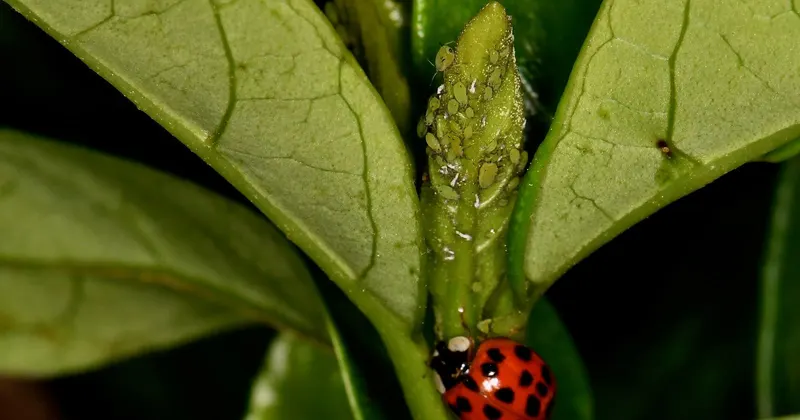
| Coccinellids | Adult ladybirds and their larvae, sometimes covered in wax | Shoots with aphids or scale insect colonies |
| Lacewings | Eggs on a fine stalk and elongated larvae | Shoots and young leaves |
| Hoverflies | Legless larvae among the aphids; adults that look like wasps | Aphid colonies |
| Parasitoids | Mummified aphids or scale insects, sometimes with an exit hole | Pest colonies |
| Predatory spiders and bugs | Vary depending on the species | The whole canopy and the ground cover |
The integrated pest management guides published by the Spanish Ministry of Agriculture describe, crop by crop, the most relevant natural enemies of each pest. Your adviser can tell you which groups to focus on in your farm.
A simple method for recording it
The key is to record beneficial fauna using the same method and on the same visits as the pest, so that you can compare the two.
- Make use of the pest sampling: on the same organs you already check, note whether there are natural enemies.
- Use presence or absence per organ: it is quicker and more repeatable than counting individuals. In the end you have a percentage of organs with beneficial fauna.
- Note the group, not necessarily the species: phytoseiids, coccinellids, lacewings, parasitoids.
- Flag mummified insects: parasitised aphids or scale insects show that the parasitoids are at work.
- Record releases: date, plot, organism and quantity, so that you can track how well they establish.
- Keep a photo when you are not sure what something is, and check it with your adviser.
Example of a record
For example, on a visit you check 50 leaves in a plot. 12 have pest mites, and in 9 of those 12 there are also predatory mites. You note: 24% of leaves with pest, 18% of leaves with phytoseiids, most of them next to the pest. With that data, your adviser can assess whether it is worth waiting and sampling again in a few days.
How to use the data when deciding
There is no general rule saying how much beneficial fauna offsets how much pest. Some integrated management guides include criteria that take natural enemies into account for certain pests, and the warning stations discuss it in their bulletins. For the rest, the assessment is made by your adviser based on the trend of the two populations.
What you can do yourself is watch how things develop: if the pest rises and the beneficial fauna rises after it, natural control may be under way; if the pest rises and no beneficial fauna appears, the risk is higher.
How to encourage beneficial fauna and keep a record of it
Recording beneficial fauna is more useful if you also take steps to help it thrive. Several practices favour it, and they should be kept in the farm's records because they are also part of integrated management:
- Ground covers between rows, which provide shelter and food for generalist predators.
- Hedges and vegetated margins around the edges of the farm.
- Localised treatments on the hotspots, when the adviser considers it possible, instead of treating the whole plot.
- Choosing the timing of interventions with the activity of natural enemies in mind.
Note when and where the covers are kept or mown, and compare that with the fauna you see on your visits.
Common mistakes
- Recording beneficial fauna only when it catches your eye, rather than on every visit.
- Mistaking coccinellid or lacewing larvae for pests.
- Not noting down releases, so their effect can't be assessed later.
- Treating without checking the beneficial fauna record.
- Using a different method on each visit.
Field visits in Agrimaps
In Agrimaps, pest sampling and monitoring lets you keep track of the pest status of each plot, compare it with a minimum and maximum threshold and see how treatments affect it, with the crop's health status always to hand. Data is entered in the field with the Android app and analysed in the web version.
Anything you see on the visit and don't want to lose, such as an area with lots of natural enemies or the spot where a release was made, you can save as a geolocated note at the exact location, with its photo, so you can return to that spot using the Google Maps route on your next visit.