
If October's fertiliser application is still in the foreman's notebook, or in an irrigation order nobody has transferred to the logbook, time is running short. Since 01/01/2026, every application of nutrients or organic matter must be recorded in the "Fertilisation" section of the farm logbook within one month at most, and from 01/09/2026 the fertilisation plan is mandatory. Below you will find the dates checked against the BOE (Spain's Official State Gazette), who is exempt, and how to organise your field logbook so that fertiliser records don't get left until the end of the season.
What the news item of 24/10/2026 reminds us of
An El Español article of 24/10/2026 reviews three obligations: a fertilisation plan for each production unit from 01/09/2026, recording every fertilisation operation in the logbook within one month at most of applying it, and technical advice on fertilisation that will arrive in phases. It is a general-interest outlet summarising a regulation, so the sensible thing is to go to the official text.
The regulation is Real Decreto 1051/2022 (Spanish Royal Decree on the sustainable nutrition of agricultural soils), amended by Real Decreto 934/2025 (BOE-A-2025-21211, BOE of 22/10/2025). The dates in the press match those in the Ministry of Agriculture press release of 21/10/2025. For your day-to-day work, what matters is that fertiliser use now has a recording deadline, just as treatments do.
Which dates affect fertiliser use on your holding
The dates are staggered. This table brings together what is already in force and what is coming:
| Obligation | From | Who |
|---|---|---|
| Record each application of nutrients or organic matter in "Fertilisation", within one month at most | 01/01/2026 | Anyone who fertilises, except for the exemptions |
| Fertilisation plan | 01/01/2026 | Irrigated crops sown or planted between 01/03/2026 and 30/06/2026 |
| Fertilisation plan | 01/09/2026 | All other cases |
| Technical advice on fertilisation | 01/01/2027 | Nitrate vulnerable zones, irrigated crops planted between March and June |
| Technical advice on fertilisation | 01/09/2027 | Nitrate vulnerable zones, all other crops |
| Technical advice on fertilisation | Two years after the date of the plan | Outside vulnerable zones |
You can keep the fertiliser record on paper or digitally. What cannot wait is the deadline: one month from the date each application is made, including those that enter with the irrigation water.
Who does not have to record fertiliser use
There are two exemptions: holdings of up to 5 ha with no more than 1 ha of irrigated land, and those with only unfertilised pasture. If you fall into one of these, the fertilisation record does not apply to you, but the rest of the logbook stays the same.
In a cooperative that coordinates its members, each holding is assessed separately. A small rainfed member may be exempt while their neighbour with drip irrigation is not, even though both receive the same technical instruction from the office.
Field logbook for farming: how to record fertiliser use within the month
A month seems like plenty until the fertiliser is split into several applications per plot over the season. These are the points that decide whether you make it or not.
Fertiliser use starts from a recorded order
If the fertiliser order is written once in the office and confirmed by the applicator when the job is done, you already have the data for the logbook. When it is given verbally to the foreman, someone will have to reconstruct it weeks later, and that is where dates and quantities get lost.
Each application on its own plot and SIGPAC parcel
Writing "fertilised the upper field" is no use for the logbook. Each application goes to a specific plot, and if your plots already have their official SIGPAC plot code (Spain's land parcel identification system) loaded, there is no need to type it in each time.
Who applied it
As with treatments, it is worth having each operation carry the person responsible. When a question comes up months later, you will know who to ask.
A fixed weekly review
Choose a day to check which fertiliser orders are done and which are still open. With a one-month deadline, a weekly review leaves you room to correct things.
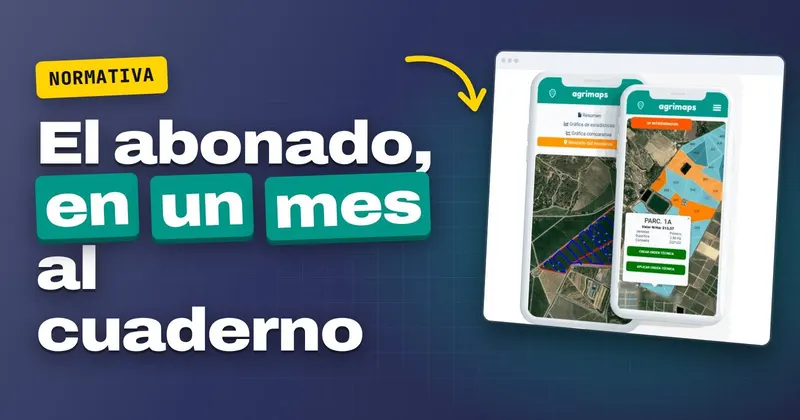
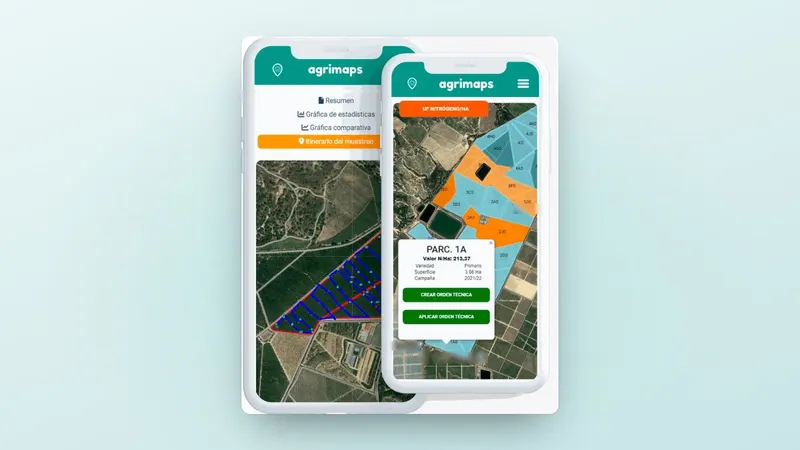
Agrimaps puts irrigation and fertiliser orders in the same technical operations tracking as treatments. From the map studio you click a plot and create or apply the technical order, and the technical office can send it to the applicator's or member's phone without paper. The map colours the plots with the data you choose, for example units of nitrogen per hectare, and from the recorded operations, each with its person responsible, the field logbook is produced with a single button.
Do your fertiliser orders still travel on paper and get copied into the logbook at the end of the month? Request an Agrimaps demo and we will show you how they are created from the plot and reach the applicator's phone.
What happens in January with plant protection treatments
Another deadline changes this winter too: the one for treatments. Here the requirement goes further: besides recording them, the medium in which they are recorded changes.
The plant protection treatment record on paper is accepted until 31/12/2026 and from 01/01/2027 it is mandatory in electronic format (art. 16.1 of Real Decreto 1311/2012, amended by the first final provision of Real Decreto 1039/2025, BOE of 20/11/2025).
For everything else, keeping the farm logbook digitally remains voluntary until the next CAP (Common Agricultural Policy) framework, according to Real Decreto 34/2025. If you want to review what data each treatment carries, you will find it in the post on the plant protection treatment record and its mandatory data, and the basic questions about the logbook in the FAQ on what a field logbook is. The "Cuaderno de explotación" page of the Junta de Andalucía (Andalusian regional government) also lists these dates.
What to do this week about fertiliser records
- Pull the list of fertiliser applications made in October and check that each one is in the "Fertilisation" section before its month is up.
- Check whether each plot has its fertilisation plan and whether it is in a nitrate vulnerable zone: that determines whether the technical advice reaches you on 01/01/2027, 01/09/2027 or later.
- Decide who creates the fertiliser orders and how they are confirmed in the field, so that the data does not depend on anyone's memory.
To see how irrigation and fertiliser orders look on the map of your plots, request a no-obligation demo or call +34 959 54 07 12.