
Under the calyx
It is found mainly on the fruit from the moment it forms, under the calyx or between fruits that touch, and also on leaves, trunk and branches.
The South African citrus mealybug (Delottococcus aberiae), known in Spain as cotonet, deforms citrus fruit and makes it smaller. We explain how to recognise it, when and where to monitor it and how to record and assess its damage with Agrimaps.
The pest
The South African cotonet is a highly polyphagous mealybug (a pseudococcid) of African origin. In Spain it was first detected in 2009, in the Valencia region, on sweet orange and clementine, and in 2019 also in Catalonia.
Adult females are oval, 2.5 to 5 mm long, and covered with a whitish layer of wax with 18 pairs of filaments around the edge; the last pair, the anal pair, is slightly longer than the rest. In its early stages it can be confused with Planococcus citri and Pseudococcus longispinus. It has many generations a year and remains active in winter.
Damage
Its most characteristic damage is that it deforms the fruit and reduces its size, to the point of making it unsaleable. The damage occurs from flowering until the fruit is 2 or 3 cm; beyond that size it no longer deforms it.
Monitoring
It is found mainly on the fruit from the moment it forms, under the calyx or between fruits that touch, and also on leaves, trunk and branches.
Populations peak in May and June according to the Junta de Andalucía, and from May to July according to the Generalitat Valenciana, when the fruit is most susceptible.
At first it appears in patches: to detect it you need to walk the whole plot.
If you suspect it is there but cannot see it, you can place corrugated cardboard traps on the trunks of several trees and check them.
With Agrimaps
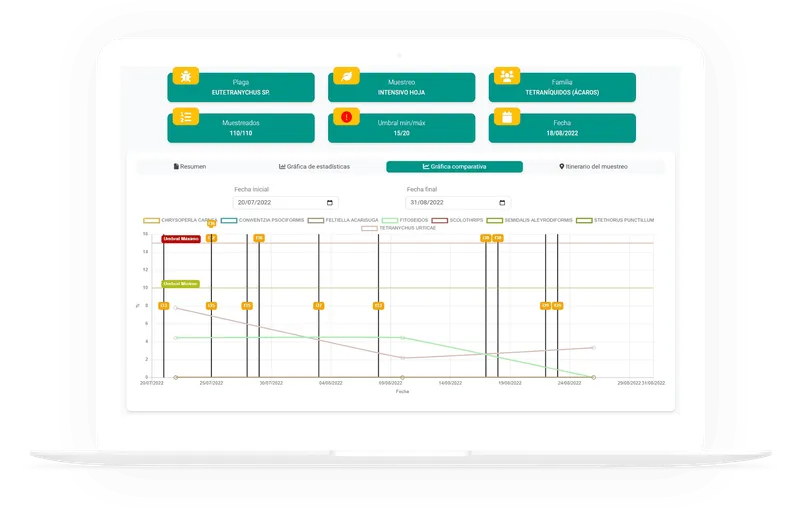
The first symptoms are usually seen at physiological fruit drop or at harvest, with deformed or undersized fruit. With Agrimaps those observations are recorded by plot and on the map.
Plus pest sampling to track the status of the pests in each plot. Everything for citrus is in citrus pests.
How to organise your spring and summer inspections is covered on our blog: symptoms and monitoring of the cotonet on the farm (in Spanish).
It is Delottococcus aberiae, a mealybug of African origin that was detected in Spain in 2009, in the Valencia region, and that deforms citrus fruit and makes it smaller.
From flowering until the fruit measures 2 or 3 cm. Its populations peak between May and July, according to the fact sheets of the Junta de Andalucía and the Generalitat Valenciana.
Mainly under the calyx of the fruit and between fruits that touch; also on leaves, trunk and branches. At first it appears in patches.
With the Delottococcus damage assessment: always on the tree, 20 trees and 20 fruits per tree. The statistics are calculated as you fill it in and the legend classifies each fruit.
Agrimaps does not recommend products: it records the treatments the technician decides on. Products must be registered and authorised for that use by Spain’s Ministerio de Agricultura, Pesca y Alimentación.
Yes. Fill in the contact form and we will show you with a demo.
Sources
The biology, damage and detection of the cotonet come from the fact sheet of the Junta de Andalucía Plant Health Service (11/07/2023) and the technical sheet of the Generalitat Valenciana ‘Cotonet de Sudáfrica: manejo en citricultura ecológica’ (July 2020), both in Spanish. What Agrimaps does comes from this website and its manuals.
Agrimaps
Your field logbook at the click of a button, with SIGPAC plots imported from the online register.
The status of pests in each plot, phenological stages and Alternaria alerts.
Alerts when the weather raises the risk of Alternaria, and the risk chart with your treatments.
Every incident with a photo, at the exact spot on the farm, with directions to get there.
Clareta, Delottococcus and calyx assessments, plus a final assessment of the fruit.
What SIGPAC is, what plots and enclosures are and where to view its map.
Agrimaps
Ask for a no-obligation demo and we will show you Agrimaps with your own farms.